From Heathrow Airport to 5 Hour Private Tour in London
From $691 per group (up to 4)
Check Availability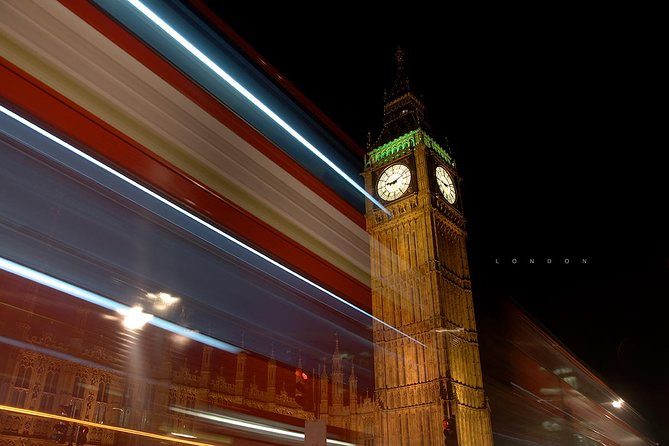
London loses eight and three-quarter hours of daylight between June and December, and on a layover that is the whole of what you can see. Month by month, with what to do about it.
Not much to the weather, and everything to the light. London in January is 8°C and damp rather than severe, and every driving product here keeps you in a vehicle between stops. Rain shortens how long you want to stand outside a palace; it does not stop the day.
Daylight is the real variable. London loses eight and three-quarter hours of it between June and December, and on a layover that is not a background fact — it is the whole of what you can see. A one o'clock landing in December leaves under three usable hours of light after the drive in.
Take a landing at one in the afternoon, allow an hour for the border and arrivals, and forty minutes for the road. You reach central London at about twenty to three. Here is what is left.
| Month | Sunset | Usable light | What that means |
|---|---|---|---|
| January | 16:20 | 3h 20m | Dark by the time you reach the second cluster |
| February | 17:15 | 4h 15m | The first month where an afternoon works |
| March | 18:05 | 5h 05m | Clocks go forward at the end of the month |
| October | 18:09 | 5h 09m | Clocks go back at the end of the month |
| November | 16:13 | 3h 13m | The wettest month, and one of the darkest |
| December | 15:52 | 2h 52m | Under three hours of light after a 13:00 landing |
Sunset times computed for central London on the fifteenth of each month and checked against the published solstice times. Usable light assumes a 13:00 landing and arrival in the centre at 14:40.
The full twelve-month table, with Met Office temperature and rainfall averages alongside, is on the weather page.
Yes, on six hours or more, and for a reason that has nothing to do with the weather. The landmarks are emptier than at any other time of year, the traffic is lighter outside the peaks, and the buildings you came to photograph are lit from about four o'clock rather than after nine.
What changes is the plan, not the answer. Front-load the day, put the outdoor stops first, and treat anything after sunset as a night tour rather than a disappointment.
Work out your own light budget before you book. Take the sunset time for your month, subtract an hour for the drive back, and that is the moment your daylight photographs stop. If the answer is uncomfortable, either take an earlier connection or accept that half the day is a night tour.
Then front-load: Westminster and the river first, while there is light on the water, and the West End afterwards, when the lights are the point. The hour-by-hour version is in a London layover itinerary.
More than you would think. Piccadilly Circus is a wall of screens and works only at night. Parliament and the Elizabeth Tower are floodlit and photograph better against a dark sky than a grey one. Tower Bridge is lit. The London Eye changes colour.
What does not work after dark: Hyde Park, St James's Park, and anything whose appeal is the view rather than the building. Plan those for the first hour or drop them.
Forward at the end of March, back at the end of October. The October change is the one that catches people, because sunset drops from just after six to just after five in a single weekend, and a plan made a fortnight earlier stops working.
If you are travelling in the last week of October, check which side of the change you land on before you decide how many hours you need.
Nothing, mostly. Rain falls on eight to twelve days a month in every month of the year at Heathrow, and it is usually light and brief rather than heavy. A driving tour handles it without noticing; you simply spend less time out of the car at each stop.
Where it matters is the walking tour, which operates in all weather and says so. Bring a hooded waterproof rather than an umbrella — Westminster Bridge is windy and you will be getting in and out of vehicles.
One layer more than the temperature suggests. You will be standing still on pavements for ten or twenty minutes at a time, which is colder than walking. In January and February that means a proper coat and gloves; in November and March, a waterproof over a jumper.
Shoes matter more than anything else. The stops are short but they add up, and the pavements are wet from October to March.
Yes. At Buckingham Palace it begins at 10:45 and runs about 45 minutes, on Monday, Wednesday and Friday throughout the year (Household Division). Winter is arguably the better time to see it, because the crowd is a fraction of the summer one.
The caveat is the same in every season: it can be altered or cancelled at very short notice in wet weather, and that decision can be made as late as the start time. Treat it as a bonus.
Outside the Christmas fortnight, yes. Security queues are shorter than in July and August, which gives your return leg more slack than the same connection would have in summer. The week either side of Christmas is the exception and behaves like peak summer.
Heathrow still asks for the same check-in window all year — three hours before an international departure — and that is the number to plan against regardless of season.
Shoot the lit things rather than the daylight ones. Floodlit stone photographs well against a dark sky and badly against a grey one, so the same building that disappoints at three o'clock in November looks its best at five.
The other trick is water. The river doubles whatever light there is, which is why the Westminster and Tower Bridge views hold up in winter when the parks do not.
It behaves like peak summer at the airport and like nothing else in the city. Security queues lengthen sharply, so build a larger return buffer than the December average would suggest. In exchange you get the West End lights, the markets and a version of London that only exists for three weeks.
Sunset is still before four, so the plan is the same as any December plan: start as early as the border allows, and treat the second half of the day as an evening tour rather than a compromise.
Almost the mirror image. June gives you sixteen and a half hours of daylight and sunset after nine, so no connection lands into darkness and the light problem disappears entirely. July is the sunniest month on the Met Office long-term average and has the fewest rain days.
What replaces the light problem is a crowd problem. Security queues lengthen, the landmarks fill, and the same six-hour connection buys you less because everything takes longer. Build a larger return buffer in July and August than you would in January.
September, and it is not close. Met Office averages give it 20°C highs, under eight rain days and 157 hours of sunshine, and the daylight is still twelve and a half hours. The school holidays are over, so the airport and the landmarks are both quieter than in August.
May is the runner-up: fifteen and a half hours of daylight, 207 hours of sunshine and crowds that have not fully arrived. March and April are good and cheap. The twelve-month table is on the weather page.
A driving tour, and an early one. The vehicle solves the weather, and starting as soon as you are through the border is what buys you daylight. If your landing is after two o'clock between November and January, book a route that includes the West End and treat it as an evening tour.
If your connection is under five hours in December, take the lounge. Three hours of which two are dark is not an afternoon. Everything is compared on London Layover Tours, and the short-connection version of the argument is on the short-layover page.
Sunset is at about 15:52 in the middle of the month, and the light has gone by half past four. A midday landing leaves under three usable hours of daylight after the drive into the centre.
Yes, and the landmarks are emptier than at any other time of year. The plan changes rather than the answer: front-load the outdoor stops and treat the second half of the day as a night tour.
Very rarely. These are private vehicles on public roads, and London does not close for rain. Changing the Guard is the one thing that can be cancelled at short notice in wet weather.
Met Office averages for the Heathrow area put January and December highs at around 8 to 9°C and lows at about 3°C. It is damp rather than severe, but standing still by the river feels colder than the number.
Not necessarily, but book an earlier one. The constraint is when the light goes, not how long the tour runs, so a six-hour product starting at ten in the morning works far better than the same product starting at one.
September, on the numbers: mild, reasonably dry, twelve and a half hours of daylight and quieter than August. May and June are the runners-up for light, and the busiest for crowds.
Chosen for the argument above rather than for what sells.
From $691 per group (up to 4)
Check Availability
From $895 per group (up to 6)
Check Availability